Monday, 2 January 2012

Saving Endangered Species


(Written for MSN's New Thinker's Index with Hyundai website, originally published here.)

The new thinking behind saving the world's most endangered animals and plants.

Tiger


A number of projects around the world are working on increasing the number of the world’s tigers (currently estimated at 3,500). Project Tiger in India for example establishes tiger reserves and combats poachers. But the World Wide Fund for Nature (WWF) leads the pack. In late 2010 they formed part of a forum - which included many world leaders - that committed millions of dollars to tiger conservation.

Black Rhino


The western African black rhino was declared extinct in 2011, but efforts continue to preserve the species elsewhere. The focus is on preventing poaching – the rhino’s horn is a highly valuable commodity in traditional medicine – by establishing and expanding protected areas and improving law enforcement activity to counter poacher’s efforts.

Beluga Sturgeon


Sturgeon may be one of the oldest fish families in existence, but they’re struggling to survive in the 21st century, having been declared the most critically endangered group of species in 2010. Beluga Sturgeon is coveted for its unfertilised eggs – considered the finest caviar in the world. Both WWF and the Bern Convention work on preserving migration routes and promoting sustainable management of the fish, while the US has banned importation of beluga caviar since 2006.

Alligator Snapping Turtle


Dwindling numbers have been caused by habitat loss and hunting, but listing as a CITES (the Convention on International Trade in Endangered Species) species has enforced limitations on international trade and exportation from the US. At the same time, projects such as that by the Tennessee Wildlife Resources Agency are seeking to reintroduce the turtle to protected river habitats.

Hawksbill Turtle


Also protected by CITES, the Hawksbill is nonetheless seeing its numbers decline thanks to the effects of climate change and continued poaching for its meat and eggs. Organisations such as the Wildlife Conservation Society and WWF are addressing the issues causing the deterioration of the turtles’ habitats, developing alternative livelihoods to prevent poaching and supporting trade controls.

Green-cheeked Parrot


Popular as pets due to their bright colours and ability to mimic the human voice, these Mexican birds have been afforded some protection since selling them in the US was prohibited. Also protected by CITES, measures are underway to monitor population decline, protect nesting areas, and use ranchers to prevent trapping and regenerate the birds’ habitats. But the illegal parrot trade remains a problem.

Mako Shark


This fearsome shark is vulnerable due to overfishing and being caught accidentally (bycatch) in fisheries for tuna and swordfish. Longfin mako sharks are also sometimes de-finned for use in shark fin soup and thrown back into the sea to die. To help improve numbers, WWF promotes smart fishing to prevent bycatch and encourages shark ecotourism, which has greater economic value than selling shark meat.

Goldenseal


This much sought-after herb is used in the treatment of infections, wounds and colds and flu. Found in Canada and the US, overharvesting and loss of habitat due to mining has seen the plant placed under the protection of CITES. WWF promotes sustainable and ethical harvest of the plant as well as increasing the supply of cultivated specimens. People buying the product can also demand to see proof it was collected sustainably or from cultivated specimens.

Big Leaf Mahogany


Deforestation in Latin America has seen a stark drop in the population of these slow-growing and highly valued trees. The big leaf subspecies was added to CITES in 2002 and campaigns by organisations such as the Natural Resources Defense Council and WWF have seen reductions in illegal logging activity. There’s also been investment in reforestation (above) and forest certification initiatives, as well as more focus on improvements in forest management and trade practices.

Giant Panda


Despite having become a symbol of conservation and protecting endangered species over the past three decades, work is still needed to protect the panda from extinction. Panda emblem bearers WWF are committed to improving, protecting and increasing habitat for pandas, as well as preventing poaching and continuing research and monitoring. In 2010 in China four pregnant pandas were reintroduced into the wild under strict supervision – work like this continues.

The Earth from the Sky


(Written for MSN's New Thinker's Index with Hyundai website, originally published here.)

Beautiful images that offer a new way of looking at the world from Bing Maps.

Bullfrog Bay Marina, Lake Powell, Utah 


Bullfrog Bay is a popular spot for boaters who want to park up their houseboats in beautiful surroundings. From 17,000 feet above, however, the view becomes one of marshmallow clouds drifting across an ominous dark blue sky.


Cabinet Gorge Dam, Idaho


Thrown up in record time in the early 1950s to combat flooding, this arch dam remains a striking presence not far from the Idaho Highway in the US. Seen from above, it’s power over, and control of, the forces of nature are even more apparent as it keeps a tight grip on the natural flow of the river.

Carved animals in a field, Ghent


Not all farm fields have to be etched with the straight lines created by tractors going about their work. One imaginative farmer near Ghent, in the Flemish region of Belgium, has been doodling in one field. How many animals can you see?

Coastline of Cap d'Artrutx, Menorca, Spain


This tiny little village on the south west corner of the Spanish island of Menorca is an unassuming tourist spot with an array of hotels and villas. From above it’s a clash of patterned colour – swirls of different shades of brown mix with dull green, both lifted by the sparkling blue of the water – of both the pools and the sea.

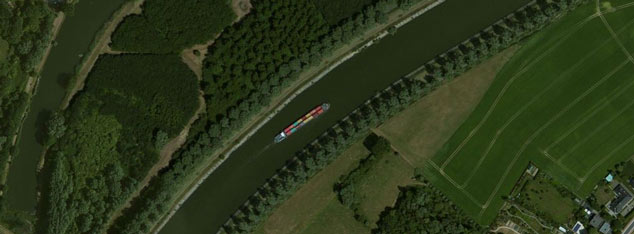
Container ship on the River Lys, France


The River Lys is better known for being polluted due to the large amounts of industrial activity along its banks in Northern France and Belgium than it is for being a beauty spot. Yet seen from above, it regains its natural beauty, the presence of a container ship only adding a pleasing splash of colour.

Crazy Mountains, Montana


Home to a large array of fauna, including many a mountain goat and the occasional elusive wolverine, the Crazy Mountains are also a popular spot for hiking and mountaineering. Seen from above, however, they take on a menacing air – throbbing and undulating as if a bubbling hot tar pit.

Everglades National Park, Florida


One of the largest national parks in the US, the Everglades protects a fragile ecosystem and a number of endangered animals, such as the Florida panther and the American crocodile. From above it is representative of how we incorporate nature’s look into our own lives, the water creating beautiful patterns that wouldn’t look amiss on curtains or wallpaper.

East of Widnes, England


Widnes is a thriving industrial town in the north-west of England, a major centre of the chemical industry since the Industrial Revolution began in the mid-19th century. From above it is a clash of industry and nature, the circuit board of buildings nestling uncomfortably amongst the greenery.

Farm fields, Washington


The undulating landscape of Washington State in the US contributes to the unusual shapes formed in these farm fields, north of the small town of La Crosse. Looking down on these well-cultivated fields, you can imagine beautiful ancient carvings cut deep into sandstone, creating beautiful intricate patterns.

Farm fields, New Mexico


These circular markings look slightly odd seen from above – more like mysterious crop circles than the innocent farm fields in New Mexico, US that they are. The circular shape is becoming increasingly common due to the growing popularity of ‘central pivot irrigation’ – often used on more difficult undulating landscapes.

Farm fields, Ghent


These more typical farm fields in Ghent in Belgium have a stark uniformity to them when seen from above that takes away any natural feel you may have walking amongst them on the ground. Such is their precise tidiness, they are reminiscent of the chips and other components of a computer motherboard.

Farm fields, north of La Solana


From the air this dry and arid-looking land in central Spain doesn’t look capable of producing much in the way of fruit and vegetables. And yet the neatly arranged dots – well-organised amongst the random shapes of the fields themselves - are abundant olive trees, thriving in the hot Spanish climate.

Great Divide Basin, US


The Great Divide Basin is a huge area of land in the US – some 4,000 square miles – that serves as a catchment area for surface water, taking it through the land and out to the Pacific and Atlantic Oceans. The water has a striking effect on the land as it travels through, shaping it into patterned cuts and grooves seen in beautiful clarity from above.

Navy bombing target area, Nevada


Nevada – the driest state in the US – has still managed to make use of its large desert and semi-arid areas – as a bombing test site. The state has a long history of nuclear testing, but these buildings (looking like some sort of code, according to some conspiracy theorists) are used as navy bombing targets.

Tulip fields, near Amsterdam, Netherlands


Tulip season in spring in the Netherlands sees acre after acre of brightly coloured fields form a myriad of rainbows across the land. Tourists flock to the Dutch countryside to see the flowers in full bloom before they are harvested for sale, but few get to see them from above, still retaining their brightness and eye-catching power.

Wednesday, 7 December 2011

Incredible Endeavours: Martin Strel

(Written for MSN's In Search of Incredible with ASUS/Intel website, originally published here.)

Long-distance swimmer Martin Strel likes a challenge, taking the likes of the Amazon River in his stride…

Martin Strel has stunned people around the world with his feats of endurance in long-distance swimming. The 57-year-old Slovenian has claimed a succession of Guinness World Records for swimming the lengths of the Danube River, the Mississippi River, the Yangtze River, and the Amazon.

His epic 66 day, 3,300 mile swim of the Amazon was documented in the award-winning film Big River Man, securing Strel’s notoriety as an unconventional athlete – known as much for his hard drinking as his incredible physical achievements.

In Search Of Incredible spoke to the fearless swimmer as he prepares for his next big swim.

How did you get into long-distance swimming?
When I was young I swam up and down many times and people didn’t understand me. I swam non-stop, sometimes for 10km, even though I was very young. It was very hard for people to swim with me, I was pretty fast already. Maybe I was born like this, who knows.

What motivates you when swimming?
When I started, I swam in competitions for money, so a better position was better for your pocket. Then a little later, when I started to swim long rivers, I kept surprising myself. At first, swimming for 55 hours non-stop was almost impossible. Now I can swim maybe 100 hours.

In the Mississippi I swam for the people that died on September 11th, 2001. I told myself I simply have to swim, even though I was tired. In the Amazon, it was everything that was happening in this beautiful, precious part of the world – I heard a lot of terrible news about people simply destroying forests there. So I said, okay, I’m going to swim the Amazon because this planet must understand what’s going on.

How do you prepare yourself for a long river swim?
Physically I must be strong, so I train twice a day in the swimming pool, in the ocean, rivers, lakes. Then as well as cross-country skiing, I’m doing a lot of hiking. Then your health is very important, you have to be very strong, a very tough guy. I’m never sick. That’s part of why I’m doing this successfully. And there’s also mental preparation. My son is with me, that’s very important. He works on the logistics. It couldn’t happen without him. That would be a huge problem for me.

On the ship’s crew, the cook is very important – what to eat, what to drink, you have to know all that before you start. Then you have to organise the media. And when you start, don’t give up. Now it’s time to show the world who you are.

Which swim has been the most challenging?
The Amazon swim was extremely hard and risky. I risked my life, it was 50/50. On the Yangtze, every day was a lucky day for me. We passed many rapids, and there was lots of pollution. On the Mississippi there was the danger of lightning. I’ve seen many deadly situations. But the Amazon was definitely the most challenging.

What river would you like to swim next?
It’s in my head to do the Grand Canyon next year. I’m still trying to find one sponsor. I’ve swam parts of the Canyon for TV shows this year, I know it pretty well. It’s beautiful. It’s very risky as it’s extremely cold water and there are many rapids, but people could follow it on the internet and TV and I think it could be a great story.

What do you love about swimming?
Swimming makes me healthy, swimming gives me power. You get to see beautiful nature and you can get a connection with animals. Also, I want to raise awareness about drinking water because clean water is very important for future generations.

Will you retire in the future and do something different?
I’m 57 and would like to swim until the end of my life. Even if you’re 100-years-old you can still swim. I might not be able to go cross-country skiing, or play basketball, but you can swim forever.


Tuesday, 5 July 2011

Wireless 2011

I wrote some words in sentences in paragraphs in a grammatically sensible (ish) order about my pleasant afternoon and evening partaking in the musical performances of a host of popular and electronic acts on a stage in Hyde Park during the Wireless Festival.


Enjoy.

Sunday, 8 May 2011

Down by the River

(Written for ITV's Perspectives website, originally published here.)

Why has House star Hugh Laurie suddenly become a blues musician? He tells us about his love of the blues.

For many, the recent foray of House star and British comic stalwart Hugh Laurie into the blues has come as something of a surprise. As the actor himself puts it: "I've broken the cardinal rule."

"Actors are supposed to act," he says, "and musicians are supposed to music. That's how it works. You don't buy fish from a dentist, or ask a plumber for financial advice, so why listen to an actor’s music?"

But for Hugh himself, his latest incarnation as a blues musician and performer is the inevitable result of a lifelong love of blues and jazz that began when he was just 10 years old.

"One day a song came on the radio," he recalls. "I'm pretty sure it was I Can't Quit You Baby by Willie Dixon – and my whole life changed. A wormhole opened between the minor and major third, and I stepped through into Wonderland.

"Since then, the blues have made me laugh, weep, dance and… well this is a family discussion, so I can't tell you all the things the blues can make me do.

"The question of why a soft-handed English schoolboy should be touched by music born of slavery and oppression in another city, on another continent, in another century, is for a thousand others to answer before me: from Korner to Clapton, the Rolling Stones to the Joolsing Hollands. Let’s just say it happens."

Now Hugh is indulging that love in a road trip to the birthplace of blues and jazz – New Orleans – for the Perspectives film Hugh Laurie: Down by the River. We follow the actor as he goes on a journey – both literally and figuratively – into blues heartland.

Not only does he explore the city where blues and jazz grew legs and started tapping its feet, he also records and performs blues classics, songs he’s loved for years, and in the process, works with some of his musical heroes.

"At the centre of this magical new kingdom [I discovered as a boy], stood the golden city of New Orleans," says Hugh. "In my imagination, it just straight hummed with music, romance, joy, despair.

"Its rhythms got into my gawky English frame and, at times, made me so happy, and sad, I just didn't know what to do with myself. New Orleans was my Jerusalem."

Now he's keen to share his love of blues with the world, to use his fame as one of the highest paid TV stars in the world to spread the word about a music he is unwaveringly passionate about.

"I could never bear to see this music confined to a glass cabinet," says Hugh, "under the heading Culture: Only To Be Handled By Elderly Black Men.

"That way lays the grave, for the blues and just about everything else - Shakespeare only performed at The Globe, Bach only played by Germans in tights. Its formaldehyde and I pray that Lead Belly will never be dead enough to warrant that.
"I love this music, as authentically as I know how, and I want you to love it too. And if you get a thousandth of the pleasure from it that I've had, we’re all ahead of the game."